A unique program on cultural studies and anthropology at Cherdachok
Go to the base activity page
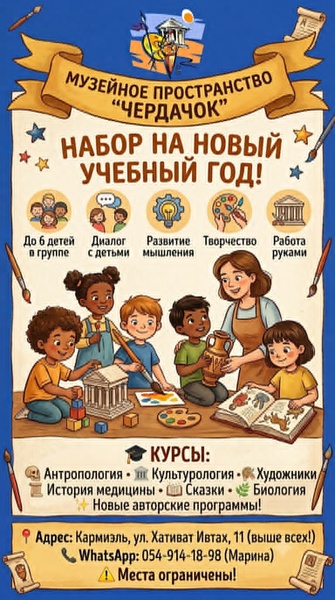
The author's program in cultural studies has existed for 5 years. And there are guys who go to study for 5 years and 4 years.
In addition, the Attic also has a course on anthropology, and both of these courses are closely related.❓️‼️What is CULTUROLOGY and why do children of the 21st century need it?
I'll try to sort everything out.What is the emphasis in education these days?
This is programming and foreign languages. Yes, but in order to create at least one computer program or game, you need to understand this material. And
A foreign language is just a tool that also needs to be used.
But there are fundamental disciplines that form systems thinking, erudition and creative intelligence.Cultural studies and anthropology are not just cramming dates, but a deep immersion in the history of human civilization through analysis, meaning and practical creation.
🧠Development of critical thinking
Cultural studies classes teach you to find cause-and-effect relationships, test other people’s hypotheses, put forward your own, challenge dogmas - only in this way can you develop critical thinking.
All these skills are very important nowadays.
Working on an algorithm (that is, programming) does not teach this.Studying history and cultural studies develops the habit of asking the main question: “Why did this happen?” Children learn to see patterns, analyzing the mistakes of the past, and understand the structure of modern society.
Knowledge of how people lived 1 million years ago, and 50,000, and 20,000 and 5,000 years ago, develops mental flexibility, the ability to look at a problem from different points of view and develops emotional intelligence (empathy).
And what effect, for example, was caused by the fact when one of the students found out that his dad had common ancestors with the Iceman (dad did a genetic test)?! And it was the son who told dad about this hunter who lived in Europe 5,000 years ago and died from a treacherous arrow.Children have to learn to work with arrays of information: Children train to highlight the main thing, compare sources and distinguish facts from myths, forming a defense against fakes and superficial thinking and avoiding templates.
And a variety of yokes help a lot here: from the ancient ones, which were played, for example, by the Sumerians, to those created by me personally for a specific activity.🏛️ Getting to know mythology, everyday life, architecture and human evolution provides the very “base” that turns a child into a deep, interesting personality who understands the world and distinguishes one cultural code from another.
At the intersection of history and anthropology, everything converges - geography, biology, literature, and art. The child begins to understand that school subjects are not isolated folders, but a single picture of the world, which, for ease of study, is divided into separate subjects.
And we live in a unique place where many things can be studied directly on site. You know, for example, that the history of the place where our city is now built goes back to the distant Paleolithic (ancient Stone Age), and even earlier: where did the mountains, for example, come from in Galilee?!
And in the classroom, children will learn the history of this place, their city, and those settlements that were here much earlier.🛠️Practice and motor skills: from thought to layout
One of the main secrets of our program at the Attic is a combination of theory and manually created models of the historical era.
When a child not only listens about the Tower of Babel, an ancient Egyptian pyramid or a Stone Age dwelling, but creates models of them with his own hands, knowledge moves from the “heard” category to the “understood and remembered” category.
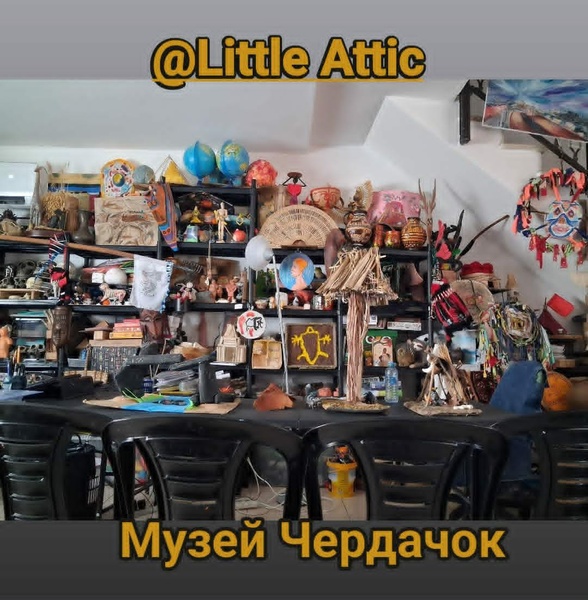
The space of the Attic Museum itself is filled with a variety of models, most of which were created with your own hands.Working with materials, drawings, volume and details develops fine motor skills, coordination, perseverance, precision of movements, spatial imagination and engineering thinking.
💖Emotional absorption and discipline
Creating historical models and reconstructing the life of ancient people turns study into an exciting research quest.
Completing a complex project or layout is a major challenge for anyone. Working on your own projects develops the ability to concentrate on a long-term task and gives tremendous pride in the result.
Studying at the Attic, children not only learn about past eras - they learn to think, analyze, create with their hands and see the deep essence of things.
| ул.Хативат Ивтах, 11, Кармиэль | |
 |
Марина |
| 972549141898 |


https://www.all4kids.co.il/en/ads/2273-avtorskaia-programma-po-kulturologii-i-antropologii-na-cherdachke/